· By Kohout Jan
How to keep journal that will actually help you grow
There is one tool in trading that can help you dramatically accelerate progress, improve results, uncover weaknesses and turn chaos into a clear system. Yet most retail traders either undervalue it or don’t use it at all.
That tool is trading diary.
Whether you trade on your own account or are part of a prop firm, keeping a structured and consistent journal can be the difference between stagnation and real growth. In this article, we’ll take a look at it:
- Why journaling is important (and necessary for long-term success)
- What a good trading diary should contain
- How to regularly evaluate your data and gain a real advantage from it
Why is a trading journal a key tool for a professional trader?
Trading is a psychological game. Most traders don’t lose money because of bad strategy – but because they can’t consistently manage themselves, their decisions, and their emotions.
Without feedback, you lose your bearings. And that’s extremely dangerous in the financial market environment.
A trading diary will give you just the feedback you need.
What the diary allows you to do:
Detect recurring errors and patterns of behaviour
For example, frequent over-hooking, hasty entries after a loss, or poor position control.
Record what really works
Not every profitable series is the result of a quality process. The diary will help you understand which strategies and setups have repeatedly produced results – and which have been haphazard.
Improve the quality of decision-making
Looking back on your own trades will allow you to make less impulsive and more systematic decisions in the future.
Separate emotion from process
Writing down your emotions and thoughts before and after you enter will help you gain distance. You will realize when you are acting rationally and when you are under pressure.
In prop trading: the key to survival
Within the prop firm, you must demonstrate consistency, handle mental pressure and follow the rules. A well-kept diary will help you identify potential risks before they become fatal.
What should a good trading diary contain?
Your journal should not be a product of intuition, but a tool with a clear structure. The key is keep track of the quantitative and qualitative aspects of each trade. Below you will find a proven list of elements that will allow you to get the most information from each position.
Technical parameters of the shop:
- Date and time of entry/exit→ When exactly was the shop opened and closed?
- Instrument / market→ What have you traded (e.g. EUR/USD, NASDAQ, BTC)?
- Direction of trade→ Long or short?
- Input and output price→ Exact values including fees.
- Position size and risk per trade→ How many units? How many % of the capital was at risk?
- SL and TP levels→ Where was capital protection and profit target placed?
- RRR (Risk-to-Reward Ratio)→ What was the potential risk/reward ratio?
- Result of the trade→ Profit, loss or BE? Expressed in $ and %.
- Type and name of setup/strategy→ Which pattern or entry logic was used (e.g. FVG, break & retest, liquidity grab)?
- Screenshots of the chart→ Ideally before entering and after exiting, mark key points.
Psychology and subjective factors:
- Emotional state before, during and after the deal→ Nervousness, boredom, impulsiveness, calmness, self-confidence…?
- Notes on the execution and the process→ Did I follow the rules? Was the execution technically correct?
- Mistakes and lessons→ What would I do differently? Was it a mistake in the decision, in the system, or in my emotions?
How to evaluate your diary effectively?
Writing down the information is step one. The real value comes when you actively work with your journal.
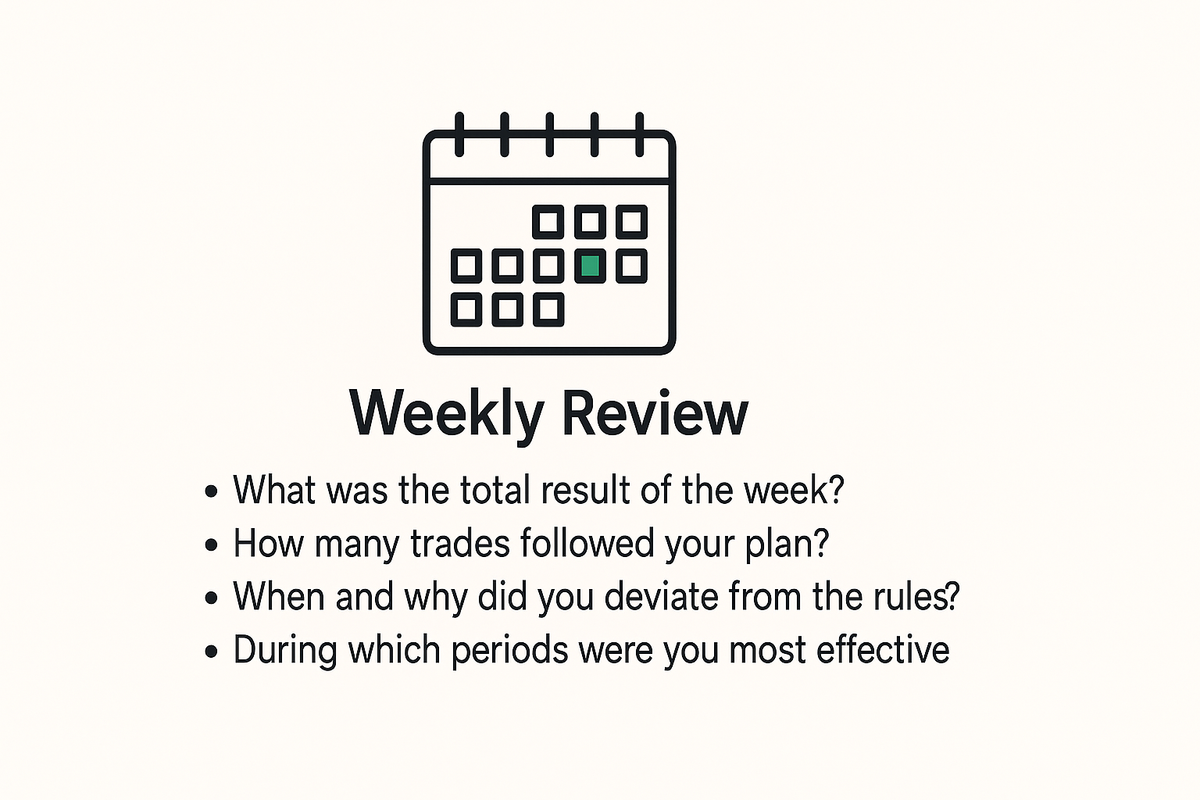
Weekly review
Take time each week to analyze:
- What was the overall result of the week?
- How many of the trades were of good quality as planned?
- When and why did the deviation from the rules occur?
- In which periods were you most effective?
Tracking statistics
Create a summary of basic metrics (ideally in Excel or Notion):
- Win rate
- Average profit vs. average loss
- The most common setups and their success rate
- The days/weeks with the worst results – and why
- Emotional triggers leading to bad decisions
Identification of patterns
Look for specific repetitions:
- Do you lose more often after two wins?
- Are you trading out of boredom or frustration?
- Do you tend to enter at low volatility?
With this knowledge, you build your personal edge – an edge that comes not only from strategy, but from deep self-knowledge.
And with us, you have a diary built right into the platform, completely free for the duration of our cooperation!
Conclusion: the diary as your cheapest and most trusted trading coach
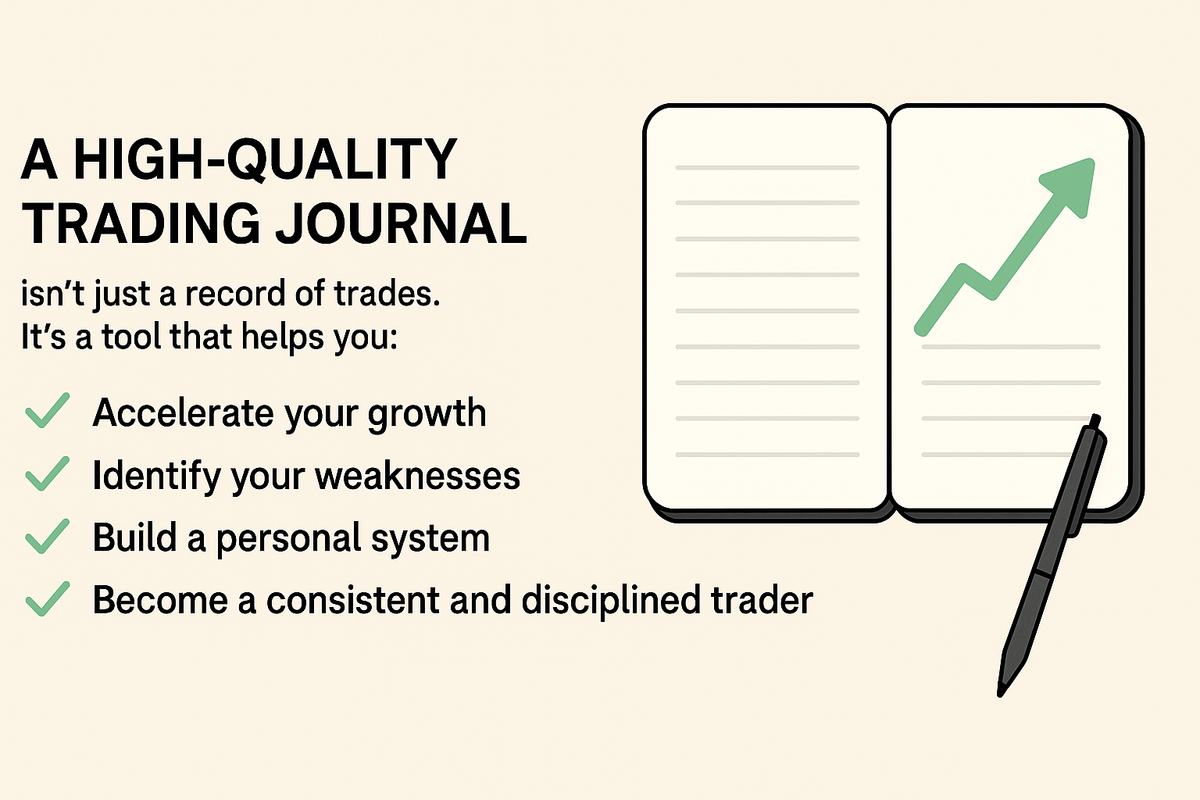
A quality trading journal is not just a record of a trade. It’s a tool that gives you:
Accelerate growth
Reveals weaknesses
Creates a personal system
Help you become a consistent and disciplined trader
Don’t wait until you start making money to start keeping a diary. Get started today – because that’s how you learn and grow.