

Uncategorized
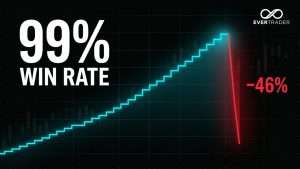
99% win rate. A single loss wiped out 46% of the profit
99% win rate. A single loss wiped out 46% of the profit https://youtu.be/JeGcRdwKynA 84 wins, 1 loss, a 6.45% gain and a profit factor of
Only until THURSDAY: 90% Profit Split + 30% Discount + FREE Course. Code: 90ET
Trading today is accessible to almost anyone. All you need is a laptop and an internet connection, and you can join the markets where trillions of dollars are traded daily. But this accessibility also tempts beginners to start trading without a plan. The result? Losses, frustration, and the feeling that trading simply doesn’t work.
The truth is different: trading works, but only if you have a clear, tested strategy. Successful traders distinguish themselves by having strict rules — when to enter a trade, when to exit, how much to risk, and how to evaluate results.
In this article, we’ll go through 10 steps to building your own trading strategy. By following them, you’ll move from chaotic “clicking around” to systematic trading with long-term potential.

Every trader should start with a simple question: Why am I trading?
Do I just want some extra income?
Am I aiming for long-term financial independence?
Or do I see trading as a way to learn capital management?
Your answer determines how aggressive your strategy will be and what trading style suits you. For example:
If you have a full-time job and a family, scalping won’t be realistic — you don’t have the time.
Swing trading (holding positions for days or weeks) may be far more realistic.
Tip: Write your goals down and keep them with your trading plan. They’ll remind you why you started when motivation fades.
Forex, stocks, indices, commodities, or cryptocurrencies — the choice is huge. Each market has its own traits:
Forex: high liquidity, trades 24/5, good for intraday trading.
Stocks: more volatility in individual assets, but also room for diversification.
Indices: popular among prop traders, combining volatility with relative stability.
Commodities: heavily influenced by fundamentals (oil, gold, natural gas).
Cryptocurrencies: most volatile, but riskiest.
For beginners, it’s best to focus on one market and master it. Trying to trade ten instruments at once often leads to shallow knowledge and messy results.

Each trader has a unique personality and time availability. Your trading style must fit you, not the other way around.
Scalping – trades last minutes; requires discipline, tight spreads, and fast decisions.
Intraday trading – positions are opened and closed within the same day; balances volatility and risk.
Swing trading – ideal for those with less time; positions held for days or weeks.
Position trading – long-term approach, suited for those who follow fundamentals and macro trends.
Tip: If you’re impatient and want results fast, swing trading may frustrate you. If you’re calm and analytical, scalping might wear you out.
Here’s where many traders make mistakes — downloading dozens of indicators and getting lost. Remember: less is more.
The most common tools are:
Price action (support, resistance, candlestick patterns)
Indicators (RSI, MACD, moving averages)
Order flow / volume (tracking trading volumes)
Fundamental analysis (macro news, company earnings)
Tip: Pick 2–3 tools and master them deeply. Knowing one tool well is far better than using ten superficially.
A solid strategy is built on specific conditions for entering trades.
Example: “I enter long only if the price breaks resistance and a bullish engulfing candle forms on the H1 chart.”
Without such rules, you’ll easily be swayed by emotions and enter trades just because “the market looks good.”
Tip: Create a checklist — if not all conditions are met, you don’t take the trade.
No strategy will work without proper risk management. Even the best traders in the world have losing trades — the difference is they keep them under control.
Risk no more than 1–2% of your account per trade.
Use a stop-loss on every position.
Define a maximum daily loss limit (e.g., 4% of account).
Example: With a $100,000 account, risking 1% means a maximum loss of $1,000 per trade. This way, you can survive a losing streak.
Knowing when to enter is only half the battle. It’s just as important to know when to exit.
Take profit – a predefined level where you secure gains.
Stop loss – the point where you accept a loss.
Trailing stop – moving the stop loss behind the price to lock in profits.
Tip: Don’t try to “guess the top.” Stick to your plan and exit consistently.

Before trading live, you need to know whether your strategy has an edge.
Backtesting – testing on historical data.
Forward testing – trading on a demo account in real time.
Tip: Test at least 100 trades before trusting a strategy with real money.
Trading isn’t just about entries and exits. The key is feedback.
Keep a trading journal.
Write down why you entered, your emotions, the outcome, and save a chart screenshot.
Regularly (e.g., weekly) review your trades to find patterns.
Tip: Sometimes the problem isn’t the strategy itself — it’s your discipline in following it.
No strategy is perfect from day one. Markets evolve, and so does your experience. It’s natural to improve your strategy over time.
But beware: don’t change it after every losing trade.
Optimize only after a larger sample (e.g., 50+ trades).
Change one element at a time (like adjusting stop-loss distance).
Tip: Stability is more important than chasing a “perfect” system.
Building a trading strategy requires patience, discipline, and the willingness to learn. But once you go through all the steps, you’ll have a tool that protects you from chaos and helps you grow as a professional trader.
Most retail traders fail for two reasons: lack of discipline and lack of capital. Anyone can design a strategy — but trading consistently without risking your own money is much harder.
That’s where EverTrader comes in:
Trade with capital up to $200,000.
Keep up to 80% of the profits you make.
Access our platform EverStation Pro, connected to TradingView.
Meet the requirements and trade without the stress of losing your own funds.
Other articles
99% win rate. A single loss wiped out 46% of the profit https://youtu.be/JeGcRdwKynA 84 wins, 1 loss, a 6.45% gain and a profit factor of

Why your strategy isn’t enough (and never will be) https://youtu.be/dTZ9psS2_g8 Most traders think they are missing a better setup. In reality, they are missing capital.

One trade wiped out 60% of his profits https://www.youtube.com/watch?v=DaTDdMo2VWc Seventeen wins, seven losses, a 71% win rate. And yet out of $15,000 in combined gains


ENG

CZ

ESP