Why One Trade Means Nothing in Trading
One of the biggest mental traps in trading is assigning importance to a single trade.
A trader opens a position — and in that moment, it often becomes personal.
If the trade works out, confidence grows and there’s a sense of control.
If it doesn’t, frustration, doubt, and the need to change something appear.
But from a statistical perspective, the reality is very simple:
A single trade means absolutely nothing.
It provides no proof of a strategy’s quality.
It offers no meaningful information.
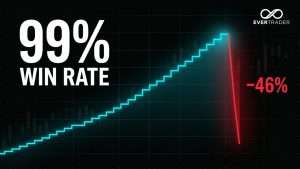
Even a strong strategy can go through a series of losses.
And a poor strategy can show a short-term streak of wins.
What truly determines success in trading is not one result.
It’s the long-term distribution of outcomes.
Why Retail Traders Often Fail
Retail traders tend to look for confirmation too quickly.
After one trade.
After one day.
After one week.
And this is exactly where the most common problems begin:
– constantly changing strategies
– evaluating results too early
– losing trust in the system
– chaotic decision-making
Professional traders don’t judge trading based on feelings.
They judge it based on data.
They ask questions like:
– Did I follow my trading plan?
– Was my risk properly managed?
– Did I enter according to my rules?
The result of a single trade is only secondary information.
Consistency Comes From a Large Sample Size
As long as a trader assigns importance to individual trades, they will keep changing strategies, risk, or approach.
And in doing so, they often destroy their own statistical edge.
Trading is not about being right on one specific trade.
It’s about being right on average across a large number of trades.
And this shift in perspective is one of the most important steps toward long-term consistency.