

Uncategorized
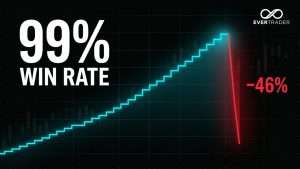
99% win rate. A single loss wiped out 46% of the profit
99% win rate. A single loss wiped out 46% of the profit https://youtu.be/JeGcRdwKynA 84 wins, 1 loss, a 6.45% gain and a profit factor of
Only until THURSDAY: 90% Profit Split + 30% Discount + FREE Course. Code: 90ET
Imagine someone tells you that a trader who loses six out of ten trades can still finish the month in profit. Most beginners reject this immediately. It sounds like nonsense. And that rejection is one of the most expensive mistakes a new trader can make.
Risk/Reward ratio — RRR for short — is one of the most fundamental concepts in trading. Yet the vast majority of traders either misunderstand it completely, or understand it in theory and ignore it in practice. This article will show you what RRR actually is, where traders go wrong, and — most importantly — why knowing RRR alone is not enough if you do not have sufficient capital to let the math work.
Risk/Reward ratio expresses the relationship between how much you are willing to lose on a single trade and how much you want to gain from it.
Put simply: RRR = potential profit / potential loss
Example:
You enter a trade at price level 100. Your stop loss is at 98 — meaning you risk 2 points. Your profit target is at 105 — meaning you are aiming for a gain of 5 points.
Your RRR in this case is 1:2.5.
That means: for every 1 unit of risk, you stand to gain 2.5 units of profit.
A simple concept on the surface. But that simplicity is exactly where the trap lies — most traders think they understand it, while in practice making mistakes that cost them dozens of percentage points in performance.

Before we get to the mistakes, let us clarify the mechanics with a real example.
You are trading EUR/USD. You identify a strong support zone and decide to enter a long position.
RRR = 90 / 30 = 1:3
If this trade does not work out, you lose 30 pips. If it does, you gain 90 pips.
Now the key question: what win rate do you need to be long-term profitable with this RRR?
The answer may surprise you: just 26% of winning trades.
The math is straightforward. If you execute 10 trades with RRR 1:3:
Even with a 30% win rate, you finish in profit. That is the power of a correct Risk/Reward ratio.
This is the most widespread and most expensive misunderstanding in trading. Beginners focus exclusively on how many trades they win. Win rate becomes their primary measure of success.
The result? They take profits too early to “maintain” a high win rate. They let losses run because they refuse to admit defeat. They end up with a 65% win rate — and a net loss — because their average winner is three times smaller than their average loser.
Win rate without the context of RRR is meaningless information.
The trade moves in the wrong direction. Instead of closing the position, the trader moves the stop loss further away — “giving it a little more room.” Price reverses and heads toward the target. Just before it hits, the trader closes early — “better safe than sorry.”
What happened? The planned RRR of 1:2.5 became a real RRR of 1:0.8. The trader eliminated the entire mathematical edge of their strategy without realising it.
RRR only works if you respect it. The plan set before entry is binding — not a suggestion.
RRR 1:5 sounds great. But if your setup has a realistic success probability of 10%, the math is still negative.
Expected value is calculated as follows:
EV = (win rate × average gain) − (loss rate × average loss)
Example for RRR 1:5 with 10% win rate: EV = (0.10 × 5) − (0.90 × 1) = 0.5 − 0.9 = −0.4
Negative expected value. Every such trade costs you 0.4 units on average.
RRR must always be evaluated together with the realistic probability of success for a given setup.
Here is the combination of win rate and RRR showing when you are in profit and when you are not. The numbers result from a simple expected value calculation over 100 trades.

Values represent net result per 100 trades in units of risk.
Look at the row for 40% win rate with RR 1:2. The result is +16 units. A trader who loses 60 trades out of 100 is profitable — as long as they maintain discipline and let the math work.
The key phrase: let it work.
This is the part that educational articles mention least often. Yet it may be the most important.
RRR math works over a sufficient sample of trades. The statistical edge of a strategy only becomes visible once you have executed enough trades for probability to balance out. That might be 50 trades. It might be 200.
The problem for beginning traders is not their strategy. It is not even discipline — though that plays a role. The problem is capital.
Imagine two traders running the same strategy. Win rate 45%, RRR 1:2. A mathematically strong, profitable setup.
Trader A runs a $500 account. Risking 1% per trade — that is $5. A drawdown of 8 consecutive losing trades (and this will happen to every strategy) reduces the account by $40. A relatively small loss in absolute terms. But the psychological pressure of eight red trades in a row causes the trader to start breaking rules. The stop loss gets moved. Profit gets taken early. The system gets abandoned. And the mathematical edge disappears.
Trader B runs a $50,000 account. Same strategy, same risk percentage. A drawdown of 8 trades costs $4,000 — painful, but manageable. The capital buffer allows the trader to stay in the system and let the statistics play out.
More capital does not mean you will trade better. It means the math of your strategy gets the room it needs to prove itself.
And this is the fundamental disadvantage beginning traders face. They do not have capital. They trade small accounts where a single losing streak causes either psychological collapse or a blown account.
Building a solid strategy with RRR 1:2 and a 45% win rate is not the hard part. Having enough capital for it to work — that is the hard part.

If you have read this far, you likely understand the math better than 80% of traders opening positions today. You know what RRR is, how to calculate it, where others go wrong, and why capital is not just an advantage — it is a prerequisite.
The practical question that remains: what do you do with this?
Traders who want their strategy to have a real chance have two options. They either spend years saving and building their own capital — risking their own money on every single trade along the way. Or they take a path that has opened professional trading to hundreds of thousands of traders around the world in recent years: prop trading.
Prop trading firms like EverTrader allow you to trade with the firm’s capital — up to $200,000. Your personal risk is zero. If you lose, it is not your money. If you profit, you keep up to 90% of the gains.
The only requirement: passing the Verification. Demonstrating that your strategy works and that you follow risk management discipline. Exactly what this entire article has been about.
The RRR math you just read is not just theory. It is precisely what gets evaluated. And precisely what — with the right capital behind it — will allow you to trade like a professional.
Want to trade without time pressure and with enough room for your strategy to breathe? EverTrader offers Verification with no time limit — your pace, your rules, the firm’s capital.
Other articles
99% win rate. A single loss wiped out 46% of the profit https://youtu.be/JeGcRdwKynA 84 wins, 1 loss, a 6.45% gain and a profit factor of
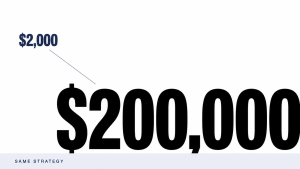
Why your strategy isn’t enough (and never will be) https://youtu.be/dTZ9psS2_g8 Most traders think they are missing a better setup. In reality, they are missing capital.

One trade wiped out 60% of his profits https://www.youtube.com/watch?v=DaTDdMo2VWc Seventeen wins, seven losses, a 71% win rate. And yet out of $15,000 in combined gains


ENG

CZ

ESP