What Actually Decides Your Results in Prop Trading

Let’s get straight to the point.
You know your setup. You know where to enter, where to cut the loss, where to take profit. You have a backtested strategy that works on paper. And yet — you didn’t pass the Evaluation. Or you did, but fell apart on the funded account.
You’re not alone. And the problem almost certainly isn’t your strategy.
The problem is the risk you feel — not the risk you actually carry
The human brain distinguishes between abstract and real risk. When you’re trading on demo, you’re calm. The moment your own money is on the line, different mechanisms kick in — fear, holding losing trades too long, closing winning positions too early, revenge trading after a losing streak.
This isn’t weakness. It’s biology. And this is where one of the biggest structural problems in retail trading lies: you’re trading with your own capital, so you can never trade the way you trained yourself to.
Strategy is a necessary condition — not a sufficient one
The formula looks simple:
Edge × Capital × Discipline = Result
Most traders work on their edge. A minority address capital. Almost nobody consciously works on how discipline degrades under emotional pressure.
Data from trading journals shows a recurring pattern: a trader with a 60% win rate on demo drops to 45% in live trading — not because the market behaves differently, but because they do.

Why prop trading structurally solves this problem
Prop trading isn’t a magic cure for psychology. It’s a structural change in the conditions you trade under.
Your maximum loss is fixed upfront — the Evaluation fee. You know exactly what you’re risking. That allows your brain to shift from survival mode into execute-the-plan mode.
Meanwhile, your potential upside is uncapped. You trade with the firm’s capital and keep 80–90% of the profits. The asymmetry here is extreme: fixed downside, unlimited upside.
No time limit Evaluation — why it matters
One of the biggest sources of psychological pressure in prop trading is the time limit. A trader who has to hit a target by a specific date will naturally drift toward over-risking as the deadline approaches. The result: a fail from panic, not from a bad strategy.
That’s why EverTrader offers an Evaluation with no time limit. You trade at your own pace, according to your own edge — without artificial pressure that corrupts execution.
All you need is a consistent approach and the discipline to apply your setup over time. The rest is math.
How to get started
If you have a strategy that works — or that you know works, but your results don’t reflect it — prop trading is worth serious consideration.
You’re not betting on luck. You’re not betting on the market going up. You’re betting that your edge holds under pressure — and the only variable that can prove it is an environment with fixed risk and unlimited time.
Other articles

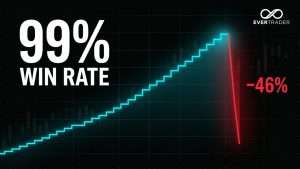
99% win rate. A single loss wiped out 46% of the profit
99% win rate. A single loss wiped out 46% of the profit https://youtu.be/JeGcRdwKynA 84 wins, 1 loss, a 6.45% gain and a profit factor of
Why your strategy isn’t enough (and never will be)
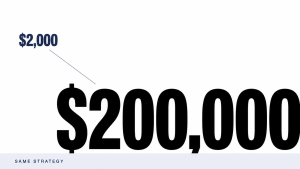
Why your strategy isn’t enough (and never will be) https://youtu.be/dTZ9psS2_g8 Most traders think they are missing a better setup. In reality, they are missing capital.

One trade wiped out 60% of his profits
One trade wiped out 60% of his profits https://www.youtube.com/watch?v=DaTDdMo2VWc Seventeen wins, seven losses, a 71% win rate. And yet out of $15,000 in combined gains
